 Cedar Pond Farms
A location scout called last week and asked whether we kept bees. We do — we have for years — and it took him three phone calls to find that out, because our website had never once said the word honey without moon attached to it. So here is the hive, written down.
Where the hive actually is
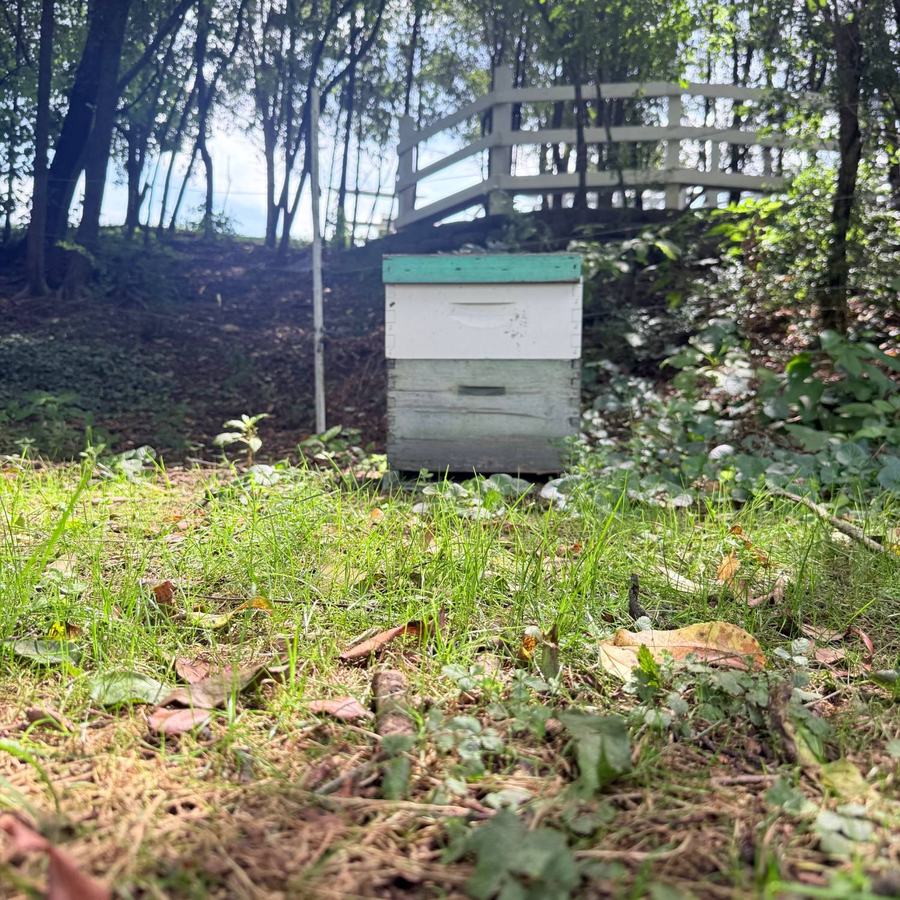
It sits at the wood line just past the white fence, on the far side of the pasture from the Grand White Barn. You can walk to it. That matters more than it sounds: on a lot of farms the working parts are somewhere behind a gate you never see, and the part guests are shown is a set. Here the hive, the flower gardens, the greenhouse and the herd are all inside the same fence line, a few minutes apart.
What the bees are working
Our bees do not have a single crop to themselves, which is exactly why the honey tastes like this particular piece of ground. Across a season they work:
- The flower gardens — the same beds we cut from for weddings and for the vases in the farm-stay kitchens.
- The pastures — clover and whatever else comes up between the Highland cattle.
- The wild edges — the wood line, the hayfield margins, and the brushy ground down toward the two-acre lake.
Nothing about that mix is planned for the bees' benefit. It is simply what a working farm in the foothills grows, and the honey is the record of it.
What “raw and local” means here
Raw means it is not heated past what the hive itself gets to, and it is not filtered down to water-clear. It keeps the pollen, it keeps the haze, and in cold weather it will crystallise in the jar — which is a sign it is what it says it is, not a fault. Set the jar in warm water and it comes back.
Local means what it ought to mean: harvested here and jarred here, at 1369 Collins Road. Not East Tennessee in the sense of a company address, and not blended with a barrel from somewhere else.
When the honey comes off
Harvest lands in late summer, after the bees have had the spring and early summer flow to build on and before they need what is left to overwinter. We never strip a hive. Some years there is a good deal of honey and some years there is very little, and both of those are honest answers — a farm that always has exactly the same amount of honey is buying some of it.
The rest of the working farm
The hive is one stop. Within the same fence line there are laying chickens and ducks, a small vegetable garden, a greenhouse, the cutting gardens, the two-acre lake stocked with catfish, and three mini donkeys who would like it very much if you scratched them. The full picture — every building, every pasture, and the farm map — is on The Farm.
Come and look at it
Photographers and film crews ask about the hive for the same reason guests do: it is a real one, in a real place, and nothing about it has been staged for a camera. If you are planning a shoot, a stay or a visit and want to know what is actually on the ground here, the honest answer is easier to give in person — get in touch and we will walk you round it.