 Cedar Pond Farms
The internet has two favorite cows, and they are the same cow at two sizes. There is the full-size Scottish Highland — a thousand pounds of shag and horn that has grazed the Scottish hills for centuries — and there is the miniature Highland, the knee-high version filling everyone's feed. The fair question, and the one people actually type into their phones, is: how does a breed that big become that small?
We raise full-size Highlands here at Cedar Pond Farms, so we get asked this at the fence line a lot. The honest answer is more interesting than "they just breed small ones." There are three different roads to a miniature Highland, and knowing which road a calf came down tells you most of what matters about it.
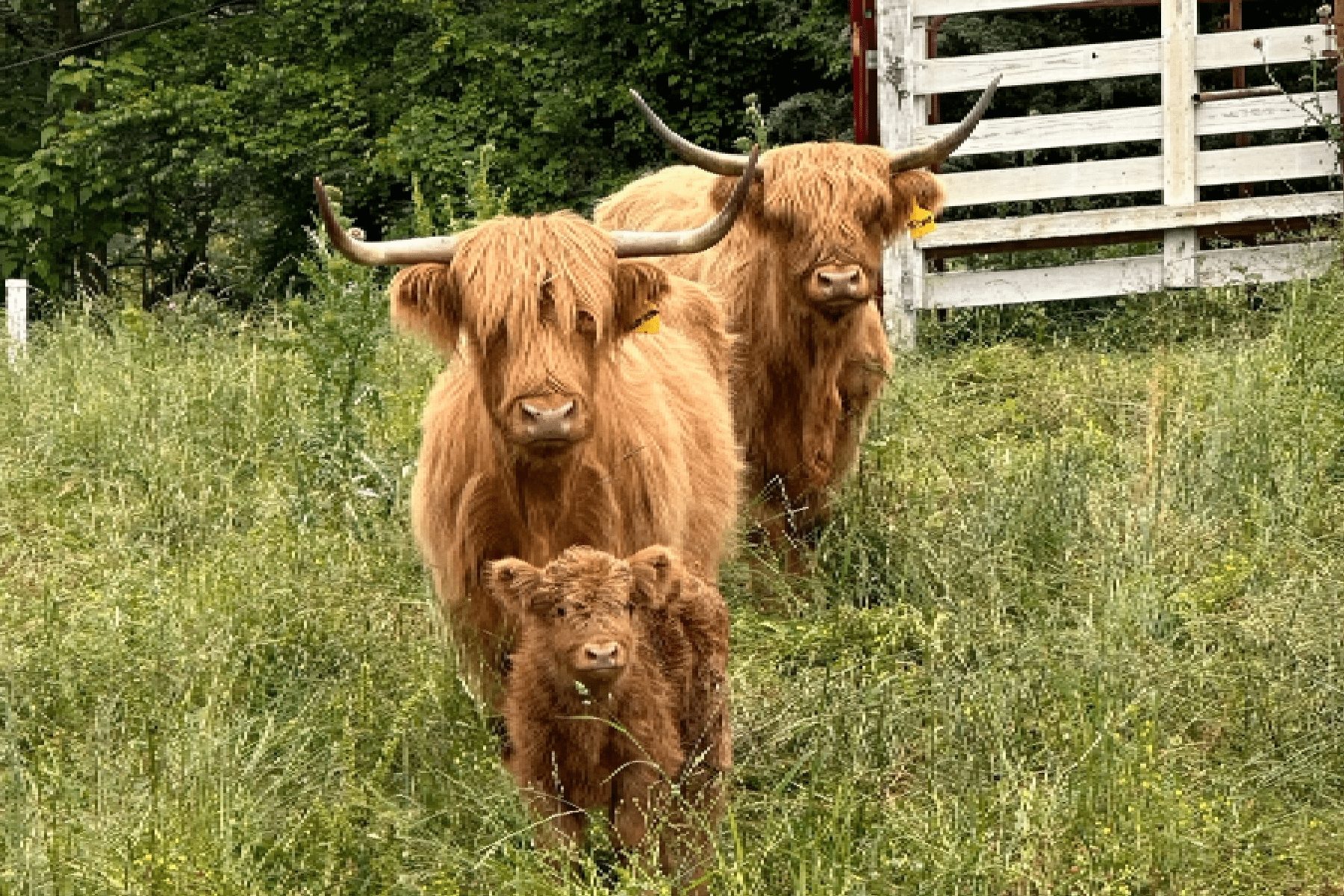
First, the honest baseline: there is no separate "mini Highland" breed
A miniature Highland is not its own breed with its own centuries of history. It is Highland stock that people have deliberately made smaller, over the last few decades, because small sells. That is not a criticism — nearly every barnyard animal you know was shaped the same way, by people choosing which animals get to be parents. But it means the word "miniature" describes a size, not a pedigree, and two minis standing side by side can have gotten small in completely different ways.
Road one: shrink the breed slowly, from the inside
The patient way is pure selective breeding: take fullblood Highlands, breed the smallest healthy animals to the smallest healthy animals, and repeat for generations. Frame size is strongly heritable, so the average creeps down over the years — slowly, honestly, and without bringing in anything from outside the breed.
Minis made this way are still genetically Highland through and through. The trade-off is time: shrinking a breed by selection alone takes decades, which is why the patient road is the road less traveled.
Road two: borrow small from a smaller breed
The faster way is a cross. Breeders pair a Highland with a naturally small breed — the Dexter, an Irish breed that stands about waist-high, is the classic partner — and then breed the offspring back toward Highland looks over several generations. The goal is an animal that carries the Highland coat, the horns and the teddy-bear face on a Dexter-sized frame.
Done well, you genuinely cannot tell at a glance. The tell is in the paperwork: a percentage Highland rather than a fullblood. An honest breeder will show you the pedigree without being asked twice.
Road three: the shortcut gene, and why honest breeders test for it
The third road is a single gene, and it deserves a plain explanation because it is the one place where "small" and "healthy" can pull in opposite directions.
Some small cattle carry a gene for chondrodysplasia — breeders call it "chondro." One copy of the gene gives a calf noticeably shorter legs on a normal body, which is the fastest possible route to a compact, low-slung animal. The catch is what happens when two carriers are bred together: a calf that inherits two copies does not survive. Reputable mini breeders DNA-test for chondro, tell you plainly whether a calf carries it, and never knowingly breed carrier to carrier. A mini with no chondro gene got small the slow way — by frame selection — and there are excellent animals on both paths.
None of the three roads is a scandal. They are trade-offs — speed against purity, size against simplicity — and the mark of a good breeder is that they will tell you exactly which road their calves came down, test in hand.
How small is "miniature," actually?
Highland cattle are not giants to begin with — a full-grown cow typically runs somewhere around 900 to 1,300 pounds, shaggy and broad rather than tall. Miniatures are commonly around half that weight, often in the 500-pound neighborhood, with height measured at the hip around an animal's third birthday. The difference in person is bigger than the numbers suggest: a full Highland meets you at chest height and a mini at your hip.
What does not shrink is the rest of the job. A mini still needs pasture, cattle company, fencing built with horns in mind, winter hay and a large-animal vet — the same honest list we walk through in the pros and cons of owning a Highland. Small is not the same as easy, and it is definitely not a house pet.
Do minis cost less? Usually the opposite
Here is the part that surprises people: miniature Highlands very often cost more than full-size ones. Scarcity and social media demand set the price, not pounds on the hoof — the same forces we unpack in why Highland cows are so expensive. If you are comparing the two sizes seriously, we wrote a side-by-side on what is actually different.
So why does Cedar Pond keep the full-size original?
Because the size is part of the animal. Our fold is the Highland as the Scottish hills made it — and when you brush one at the fence, the scale is honestly most of the magic: a creature that outweighs a piano choosing to stand still and lean into you. We would be lying if we said the minis aren't charming, though. If a few small ones ever join the fold here, this page is where you'll hear about it first.
Until then, come meet the originals. They are very fluffy, very gentle, and very much full-size.
Start with the complete mini Highland guide, or the full breed pillar — everything about Highland cows, in one place.