 Cedar Pond Farms
Somewhere between the shaggy fringe and the enormous horns, the Scottish Highland cow became one of the most searched-for animals on the internet. Most of what comes back is a photo gallery. This is the other thing — what the breed actually is, written by people who feed forty of them every morning.
What a Highland cow actually is
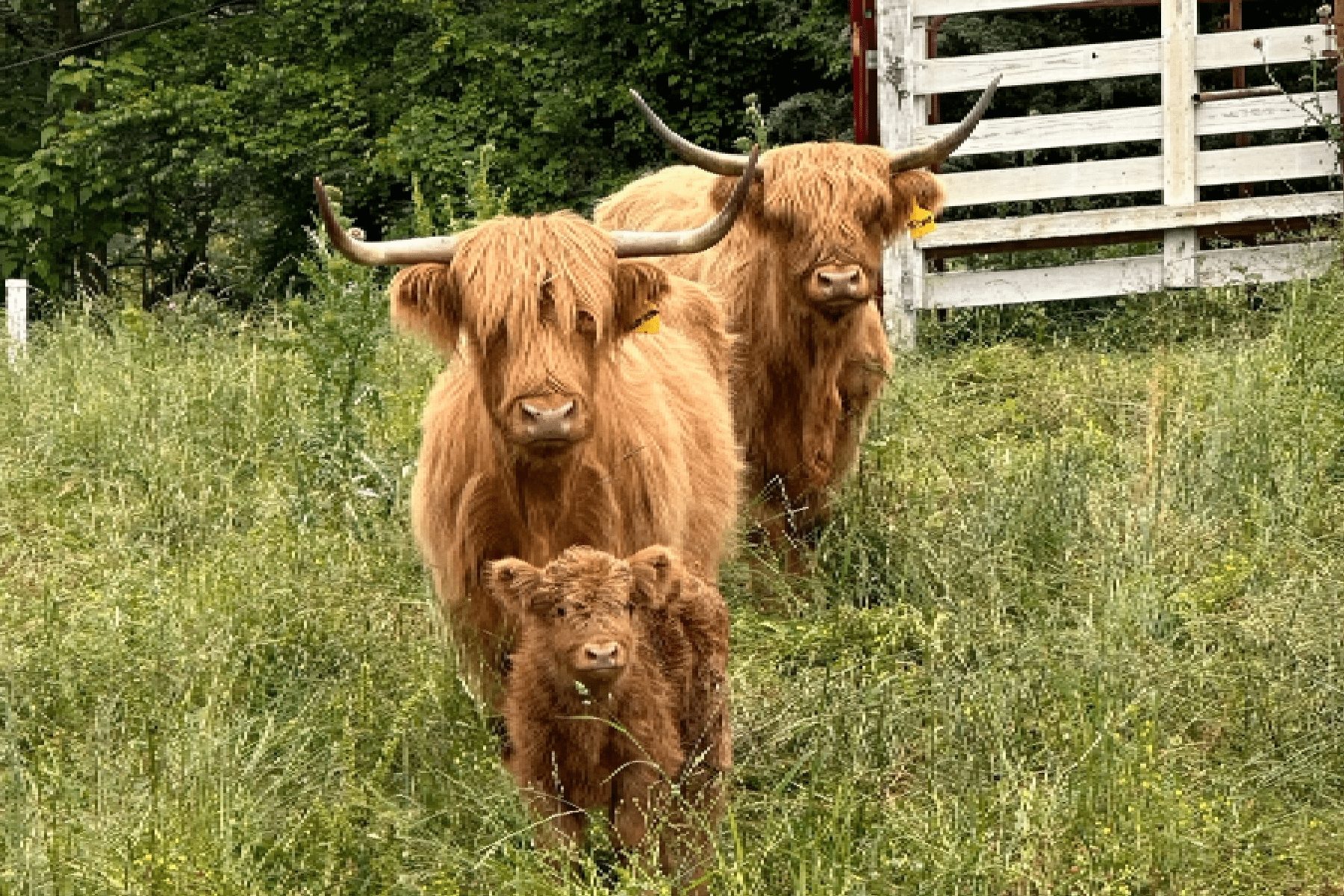
The Highland is a Scottish beef breed, and one of the oldest registered cattle breeds in the world — the first herd book was opened in 1885, which makes the paperwork older than most countries' cattle registries. They come from the Highlands and the Western Isles of Scotland, where the weather does the selecting: wind, rain, thin grazing and a long cold season.
Two strains existed historically. The smaller, mostly black Kyloe came from the islands; the larger, redder animals came from the mainland. Crossbreeding has largely merged the two, and the ginger coat everybody pictures is now the most common colour rather than the only one.
You will see the name spelled a dozen ways — highlander cow, hyland cow, heiland coo (the Scots pronunciation, and the one they'd use at home). They are all the same animal: Bos taurus, breed name Highland, no hyphen and no S on the end when you're being formal about it.
The coat is the whole trick
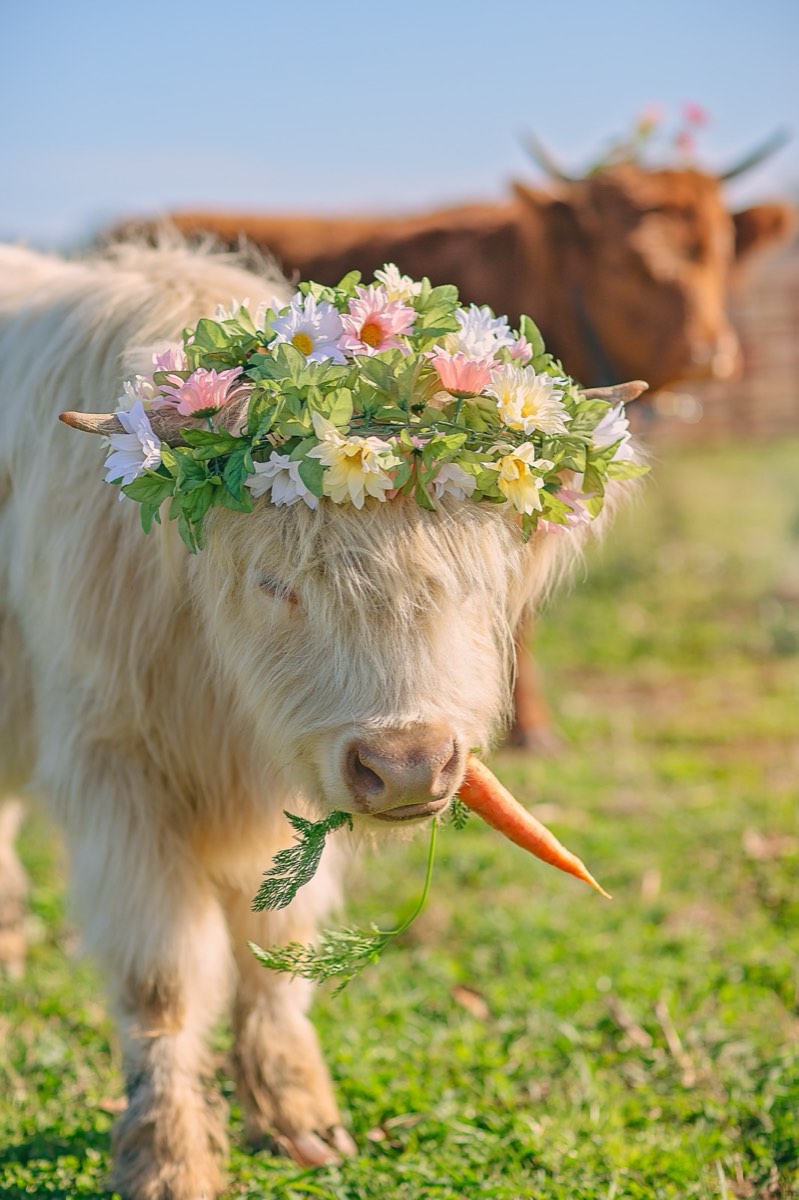
A Highland has a double coat, and that is the single most important fact about the breed. Underneath is a dense, oily undercoat that sheds water. Over it lies the long outer hair — up to thirteen inches — that everybody wants to touch.
Together they do a job most cattle need body fat for. A Highland does not have to carry a thick layer of back fat to survive a Scottish winter, because it is wearing its insulation on the outside. That has a consequence people rarely connect: it is part of why Highland beef is lean.
The fringe over the eyes has a name — the dossan — and it is not decoration. It keeps wind, rain, snow and flies out of an animal's eyes, which in a Scottish January is the difference between grazing and standing still.
Colours run ginger, red, yellow, dun, silver, white, brindle and black. On this farm you will meet most of that list in one pasture.
⚠️ One thing the coat is not: warm-weather proof. Highlands shed heavily in spring and manage summer heat far better than their appearance suggests, but they want shade and water like anything else. A Highland in Tennessee in August is a Highland standing under a tree.
Both sexes have horns — and that surprises people
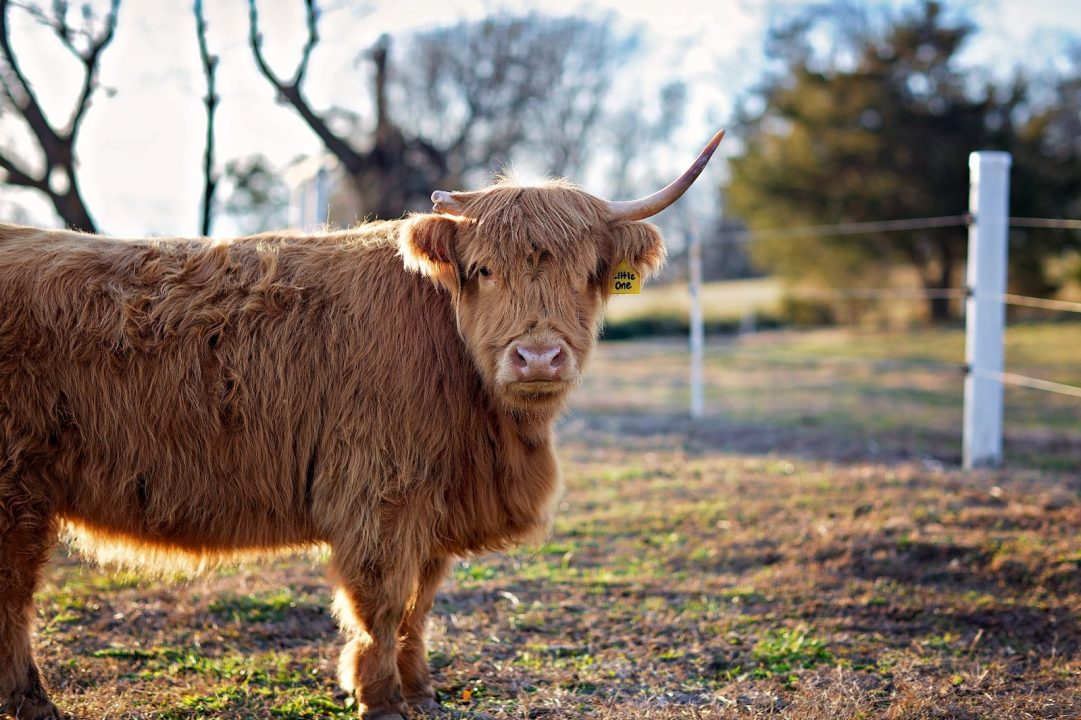
Cows and bulls both carry horns, which is unusual among cattle breeds and is the reason a Highland cow reads as so imposing at a distance. The shape differs by sex once you know what to look for: a cow's horns tend to rise and curve upward with finer tips; a bull's come out more horizontally, thicker at the base, often angling forward.
Horns are tools, not weapons. Highlands use them to break ice on water, to move snow off grazing, to reach through gorse, and to scratch the parts of themselves they cannot otherwise reach. They will also use them to establish who eats first — herd order is real, and it is settled with far more posturing than contact.
More on the horns, and the one exception people ask about →
Temperament: the reputation is mostly earned
Highlands have a deserved name for being calm, curious and easy around people. They are not skittish in the way many beef breeds are, they habituate to handling quickly, and a well-socialised Highland will walk over to see what you are doing.
Two honest caveats, because the internet leaves them out:
- A cow with a calf is a different animal. Highland mothers are protective and competent. That is a virtue in a herd and a reason to keep your distance in a field.
- Those horns are wide and she does not know where the ends are relative to you. Most Highland-related injuries are not aggression; they are a friendly animal turning her head.
They are also brighter than the placid expression suggests — they learn routines, recognise individual people and remember which of them brings food. More on how smart a Highland actually is →
How big does a Highland cow get?
A full-size Highland cow runs roughly 900–1,300 lb and stands about 3½–4 ft at the shoulder. Bulls run 1,500–2,000 lb. Horn spread on a mature animal commonly reaches 3–5 ft tip to tip, and that width is what makes them look larger than the scale actually says.
They are, by beef-cattle standards, a moderate-sized breed. An Angus bull outweighs a Highland bull comfortably. The horns do the rest of the work.
Mini and miniature Highlands
The most-searched question in this whole topic, so here is a straight answer: a mini Highland is a Highland bred down in size, typically under about 42 inches at maturity, and a micro-mini smaller still. They are real animals, not a gimmick, and the smallness comes from selecting small parents and in some lines from a dwarfism gene — which is why serious breeders test for it.
Cedar Pond Farms keeps full-size Highlands and does not sell minis. We say that plainly because a great many pages on this subject are written to sell you one. Our herd is full-size because full-size is what a working pasture and a beef breed were designed around, and because a 1,100 lb cow that has grown up around people is, in practice, the gentler animal to stand next to.
The complete mini Highland guide → · Mini vs full-size, what actually differs → · The genetics that make them small →
What they eat, and why they are cheap to keep
Highlands are browsers as much as grazers. They will eat grass, and then they will eat the things most cattle walk past: brush, briars, saplings, rough weeds, the scrubby edge of a field. That habit is why they are used for conservation grazing across Britain and Europe — put Highlands on neglected ground and they clear it without a machine.
The practical effect for a smallholder is that a Highland converts poor forage into condition on ground that would leave a continental breed thin. They need what any cattle need — clean water, shade, minerals, shelter from the worst of it — but they are famously undemanding about the quality of the grazing.
How long do they live?
Highlands are long-lived by cattle standards: 15–20 years is normal, and cows commonly calve productively into their teens. That longevity is part of the breed's economics — a cow that raises calves for fifteen years is a very different asset from one replaced at eight.
Calf to shaggy legend: the whole life cycle →
What are Highland cows actually good for?
- Beef. Lean, well-marbled, slow-grown, and genuinely regarded — the low back fat that comes with the double coat shows up on the plate.
- Milk. They are not a dairy breed and will not be mistaken for one, but the milk is unusually high in butterfat. A house cow, historically, rather than a parlour cow.
- Clearing ground. Conservation grazing, as above.
- Hardiness. They calve easily, need little intervention, and winter outside in weather that would require a barn for other breeds.
- Being themselves. Worth saying out loud, since it is why most people are reading this: the breed's presence is now a real part of its value. Ours meet several thousand visitors a year.
Meat, milk, or both — the longer answer → · The honest pros and cons of owning one → · Can I keep one in my backyard? →
What does a Highland cow cost?
Prices move with the market and with pedigree, so treat any single figure with suspicion. What is stable is the shape of it: a registered heifer from proven lines costs multiples of an unregistered steer; minis command a premium over full-size purely on demand; and the purchase price is the small number. Fencing, water, shelter, hay, minerals, a vet who will come out, and the twenty years of mornings are the real cost.
The question worth asking before the price question is whether you want to keep cattle at all. Highland cows as pets: the shaggy truth →
Where to actually meet one
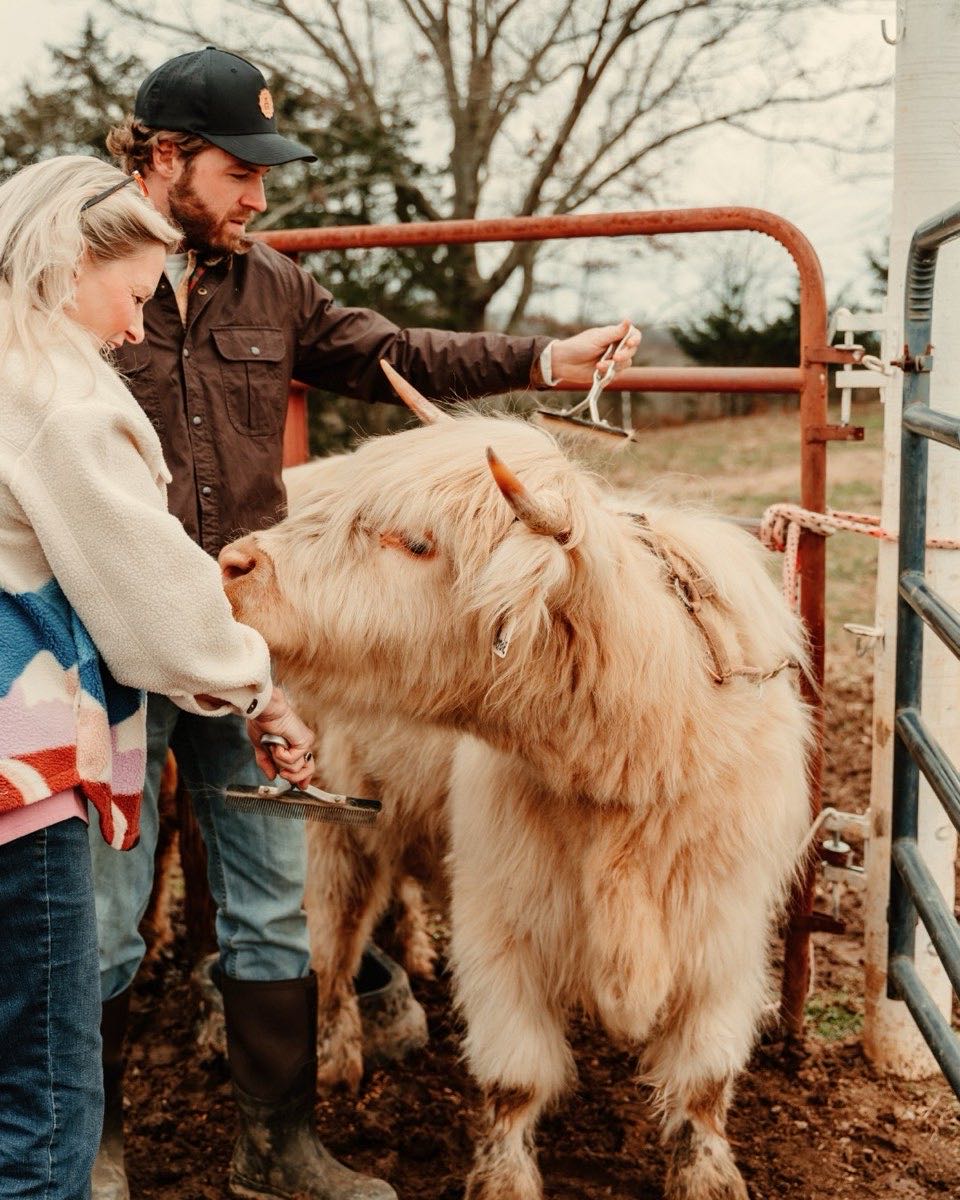
Photographs of Highlands are everywhere; standing next to one is a different experience, largely because of the scale and the fact that she is looking back at you. Our herd lives on a working farm in the foothills twenty-five minutes from Knoxville, and the encounters are deliberately small-group so the animals stay relaxed and nobody is queuing.
You do not have to come to us to see one — there are good herds across East Tennessee and well beyond. If you are somewhere else entirely, start here →. If you are near the Smokies, the Fluffy Cow Encounters page is what we run and what it costs.
The short version
- A Scottish beef breed, herd book opened 1885, built by Highland weather.
- Double coat, not fat, is what makes them cold-hardy — and part of why the beef is lean.
- Both sexes have horns; they are tools, and the wide sweep is why they look so large.
- Calm and curious, with two real caveats: a mother with a calf, and the horn ends.
- Cows 900–1,300 lb; minis are a real, separately-bred thing that we do not keep or sell.
- Browsers as much as grazers, which is why they thrive on rough ground.
- 15–20 years, calving well into their teens.